
RKE2 vs. Vanilla Kubernetes: Why Kubernetes Architecture Choices Matter for Serious Workloads

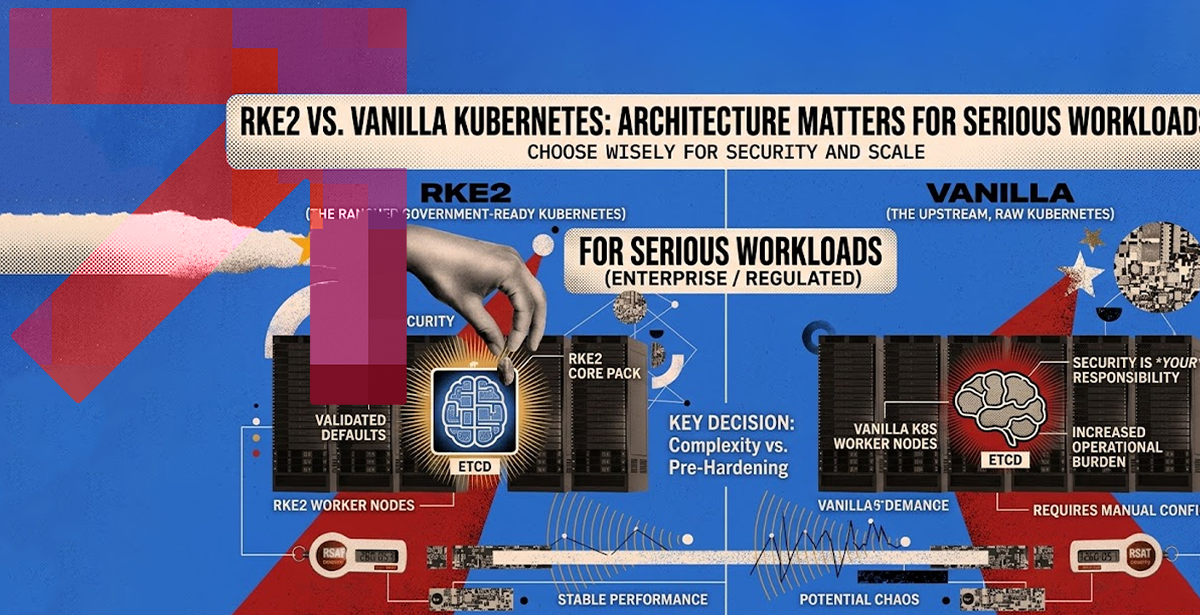
Not all Kubernetes is created equal. Whatever you decide defines how your infrastructure behaves under scale, stress, and scrutiny. What looked like ‘just a setup preference’ begins to shape uptime, operational overhead, and even engineering velocity.
That’s why the Kubernetes architecture is crucial and shouldn’t be taken lightly.
Kubernetes, by design, is a composable system. It doesn’t enforce a single way of running clusters; it allows you to assemble one. Two options in particular have been generating considerable buzz in tech forums: plain Kubernetes (i.e. vanilla) and RKE2.
At first glance, both options may appear functionally identical. After all, they run the same core control plane, expose the same APIs, and support the same workloads. But beneath that surface-level compatibility lies a fundamental difference in philosophy.
Vanilla Kubernetes represents this philosophy in its purest form. It gives teams direct access to upstream capabilities, minimal abstraction, and maximum flexibility.
On the other hand, RKE2 approaches the same problem from the opposite direction. Instead of exposing every building block, it packages Kubernetes as a secured, opinionated distribution.
It makes deliberate choices about configuration, security baselines, and component integration so that teams can move faster without assembling the entire control plane from scratch.
To help you make a more informed choice for your next project, read on.
Kubernetes Orchestration at the Foundation
Vanilla Kubernetes is the upstream open-source distribution maintained by the CNCF. It’s powerful, flexible, and deliberately unopinionated. That flexibility is both its strength and its risk.
- Out of the box, upstream Kubernetes ships with defaults designed for broad compatibility, not maximum security.
- Anonymous authentication is enabled on the API server.
- Privileged containers are permitted.
- Network policies are absent by default.
- RBAC exists but isn’t enforced with granularity without significant post-install work.
Getting your Kubernetes orchestration up and running is fast. Getting it secure takes weeks of manual hardening.
For teams evaluating distributions, the first architectural decision determines how much of that hardening work is already done. That’s why container orchestration services such as ours tend to start from that question every time.
RKE2: A Kubernetes Architecture Built for Compliance from Day One
RKE2 is SUSE’s government-hardened Kubernetes distribution. It’s built with security as a first principle. Every default reflects the CIS Kubernetes Benchmark. So, the moment a Kubernetes cluster comes online with RKE2, it already satisfies the bulk of CIS v1.6+ controls.
- Anonymous API server authentication is disabled.
- Secrets are encrypted at rest by default using AES-CBC.
- Pod Security Admission enforces at the Restricted level out of the box.
- etcd communication uses mutual TLS.
- FIPS 140-2 validated cryptography is available for classified or regulated environments.
These aren’t optional add-ons. They’re baked into the Kubernetes architecture from the first boot.
How the Kubernetes Cluster Security Posture Compares
The gap becomes measurable when you run a CIS benchmark scan on both distributions. A fresh vanilla Kubernetes cluster typically fails 40–60% of CIS controls. Meanwhile, a fresh RKE2 cluster typically passes 85–90% without any additional configuration.
That delta has direct compliance consequences. Frameworks like SOC 2, HIPAA, and NIST SP 800-190 map directly to these controls. Each failed control is an audit finding. And each finding requires remediation, documentation, and retesting.
With RKE2, that backlog doesn’t exist before your first workload runs.
Microservices Architecture and the Expanding Attack Surface
Decomposing a monolith into microservices — often 50 to 100+ individual services — multiplies your attack surface proportionally. Each service is a potential entry point. Unencrypted inter-service traffic is a lateral movement risk that internal security teams consistently underestimate.
For teams running cloud native architecture at scale, RKE2’s integration with Istio service mesh addresses this directly. Mutual TLS between pods is enforceable as a default, not retrofitted after a breach.
Kubernetes Management Overhead: What RKE2 Actually Changes
Teams sometimes worry that RKE2 adds to the complexity of Kubernetes management. In practice, however, it actually reduces it.
Hardened defaults upfront eliminate weeks of post-deploy remediation work. SUSE provides long-term support with predictable CVE patching cycles. And for teams using Rancher as their control plane, managing multiple clusters across hybrid on-premises and cloud deployments becomes a single-pane-of-glass operation.
With the help of managed DevOps services, you can further layer CI/CD automation, infrastructure as code, and continuous security scanning on top of that foundation. That way, the platform stays hardened without ongoing manual intervention.
Now, that said, the real management overhead lies in using vanilla Kubernetes. Expect to deal with perpetual audit cycles, manual hardening scripts, and policy engine work that should have been default from the start.
Case Study: DPL’s Air-Gapped RKE2 Deployment
DPL architected a fully air-gapped RKE2 platform for a national defense organization, The project required:
- Zero external internet connectivity
- 100+ containerized microservices in production
- 99.95% availability across a high-availability multi-master configuration and zero security incidents
The stack — RKE2 with Rancher, Istio mTLS, HashiCorp Vault, and Falco runtime security — produced those results because the underlying Kubernetes architecture was engineered to be secure by default, not secure by configuration. Every control was already in place. No remediation sprint was needed after go-live.
The Right Kubernetes Architecture for Serious Workloads
Choosing between RKE2 and vanilla Kubernetes is a risk-related decision, not a technical preference.
Vanilla Kubernetes becomes secure with significant post-install investment. On the other hand, RKE2 starts secure and reduces the operational burden of staying that way. That’s why it’s a Kubernetes architecture that earns its place in production.
And for teams running regulated workloads, government platforms, or solutions where a misconfiguration becomes a headline, this isn’t a close call.
The Bottom Line
A lot depends on the Kubernetes architecture you decide for your next project. And if you wish to start this right, have the best tech partner guiding you through.
DPL’s Kubernetes cluster design and deployment services cover the full lifecycle — from distribution selection through to managed Kubernetes infrastructure and ongoing platform operations.
So, if you’re building for serious workloads, start with a foundation designed for them. Courtesy of our seasoned experts.
Bonus: Frequently Asked Questions
What is the main difference between RKE2 and vanilla Kubernetes?
RKE2 is a hardened Kubernetes distribution that ships with CIS Benchmark-compliant security defaults, FIPS 140-2 cryptography, and secrets encrypted at rest.
Vanilla Kubernetes is the upstream distribution with broad, permissive defaults that require substantial manual hardening before production use in regulated environments.
Is RKE2 harder to operate than vanilla Kubernetes?
Not in practice. RKE2’s hardened defaults reduce long-term operational burden by eliminating the post-install security configuration that vanilla Kubernetes demands. SUSE’s predictable support cycle adds further operational stability.
When should I choose RKE2 over vanilla Kubernetes?
Choose RKE2 when your workloads require compliance with SOC 2, HIPAA, FedRAMP, or similar frameworks. Or when you’re operating in regulated, defense, or air-gapped environments where security must be enforced at the architecture level, not bolted on afterward.