How Continuous Integration and Continuous Deployment Cuts Deployment Time to Seconds

There’s a moment every engineering team dreads. A production bug is live, customers are affected, and the fix is ready. However, the deployment will take four hours. This isn’t due to a technical problem; rather this is a pipeline problem.
Something that can easily be solved with continuous integration and continuous deployment.
Teams that get it right don’t just ship faster. They reduce risk, shorten feedback loops, and make releases routine instead of stressful.
What Is CI/CD and Why Deployment Speed Matters
CI/CD combines two terms. CI stands for Continuous Integration, which builds and tests code automatically on every commit. Meanwhile, CD means Continuous Delivery or continuous deployment. The key difference lies in the final step.
Continuous Delivery automates the release process up to a manual approval gate. Continuous deployment removes that gate entirely. Every code change that passes tests ships to production automatically.
Slow deployments do more damage than most teams realize. They push teams toward large, infrequent releases with a high blast radius. As a result, they erode confidence in the release process.
According to the DORA State of DevOps Report, elite teams deploy 973 times more than low performers. The gap isn’t talent; it’s pipeline design.
The Anatomy of a Fast CI/CD Pipeline
A fast CICD pipeline isn’t a single tool doing everything. It’s a well-sequenced set of stages, each designed to fail fast and pass clean.
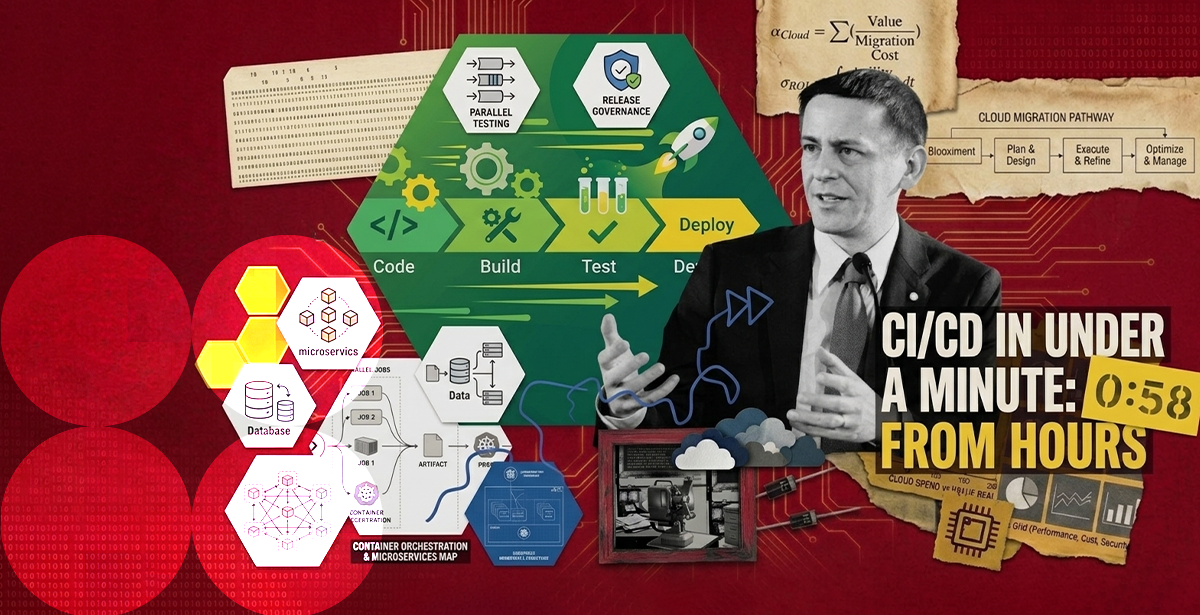
High-performance pipelines follow a consistent pattern. A code commit triggers the build immediately. Unit tests, security scans, and linting run in parallel. A Docker image is built and pushed to a registry.
The change deploys automatically to staging and gets smoke-tested. Production then receives an automated rollout with health checks. If anything fails, rollback is instant.
The operative word here is parallel. Teams that run tests sequentially add 10 to 15 minutes of dead time to every build. Parallelism across test suites and build stages is the single biggest lever for cutting pipeline duration. Most modern CI systems support it natively.
What’s Slowing Your DevOps Pipeline Down
Most DevOps pipeline slowdowns come from four fixable root causes.
- Sequential Testing – This is the biggest offender. Running unit, integration, and security tests in series when they could be concurrent jobs wastes time on every build. Split them into parallel jobs to fix this immediately.
- Uncached Build Layers – Rebuilding Docker layers from scratch on every run is expensive and unnecessary. Layer caching cuts build time significantly, and requires minimal configuration.
- Manual Approval Gates – These introduce wait time that automation should replace. Unless compliance requires a human sign-off, replace these gates with automated smoke tests and promotion rules.
- Monolithic Test Suites – A suite that takes 40 minutes to run will never enable sub-5-minute pipelines. Tier your tests: fast unit tests at commit time, slower integration tests as parallel jobs.
How GitLab CI/CD Accelerates the Path to Sub-Minute Deployments
GitLab CI/CD is among the most capable continuous integration tools for teams focused on pipeline performance. It offers native support for parallel jobs, Docker layer caching, and dynamic child pipelines. Configuration lives in a single .gitlab-ci.yml file in your repository.
A well-tuned GitLab pipeline with warm caches and maximized test parallelism runs in under five minutes for typical changes. Critical hotfix paths can execute in under 60 seconds. The same principles apply to AWS CodePipeline, Jenkins, and other toolchains.
Continuous Deployment in Practice: What DPL Has Delivered
DPL has implemented continuous deployment pipelines across government platforms, defense infrastructure, and commercial SaaS products. The results are consistent.
One such client is NJS, a US-based facility management company. NJS processes over 500,000 work orders annually across 50 US states.
We created a solution using Amazon ECS, AWS CodePipeline, and parallelized test automation. With it, we were able to cut deployment time from four hours to under one minute. Manual deployment effort further dropped 90%. All while maintaining SOC2 Type II compliance throughout.
For a defense organization with an air-gapped Kubernetes cluster, DPL built an on-premises CI/CD pipeline. Execution time dropped from hours to under ten minutes. Zero external connectivity. Full defense-grade security remained intact.
Where to Start If Your Pipeline Is Still Taking Hours
Fix parallelism first. It delivers the largest time savings with the least architectural change. Add caching second. Its impact compounds as your image layers stabilize.
Then refine your deployment strategy to reduce production risk. Blue-green, canary, and rolling deployments each serve different risk profiles. Choose based on your release frequency and rollback requirements.
💡 You need to give ample consideration to your deployment strategy. This as the final mile of your development journey. And it’s not just about pushing code; it’s about uptime and user trust. A solid strategy ensures that if something breaks, you can roll back instantly without a headache. To help you further, make sure to check our detailed guide on choosing the right Kubernetes deployment strategy.
At scale, pipeline architecture gets more complex. Microservices, multi-region deployments, compliance constraints, and air-gapped environments each add layers. That is where DevOps services are built to help, especially from reliable IT innovators such as DPL.
The Bottom Line
Continuous deployment isn’t a luxury for high-velocity startups. It’s the baseline for any team that wants to ship reliably and stop treating releases as high-stakes events.
The architecture is well-understood. The continuous integration tools exist. What it takes is the experience to implement it correctly.
Through our cloud and DevOps services, we have delivered CI/CD transformations across industries. From government citizen platforms to air-gapped defense infrastructure, the experience is there. If your pipeline needs a rebuild, let’s talk.