
GitLab CI/CD vs. AWS CodePipeline: What’s Right for Your Team?

Choosing the wrong CI/CD stack is an expensive mistake. Not just in terms of licensing costs, but also in the engineering hours lost to workarounds, brittle deployments, and pipelines that actively fight the architecture they’re meant to serve.
As software teams accelerate their release cycles, the decision between GitLab CI/CD and AWS CodePipeline has become one of the most consequential calls in any DevOps transformation.
Now both are production-tested tools deployed at serious scale. Similarly, they solve the core problem of automating software delivery.
But they’re built on fundamentally different philosophies. And the wrong fit may lead to friction at every layer of your delivery pipeline.
💡Your business won’t thrive without optimized CI/CD pipelines. Understanding this pipeline is vital because it transforms manual, error-prone releases into a streamlined, automated pulse. Therefore, continuous integration and continuous deployment isn’t a technical choice; it’s a culture of quality. By automating your tests and deployments, you trade ‘deployment anxiety’ for development velocity.
But What Makes a Great CI/CD Stack?
Before declaring a winner, it helps to agree on what to actually optimize for.
The best continuous integration tools are:
- Fast to configure
- Transparent when things fail
- Composable with your existing infrastructure
- Avoid lock-in that becomes painful to unwind
According to DORA’s software delivery performance research, elite engineering teams deploy 182x more frequently than low performers. The right DevOps pipeline is what makes that gap achievable — or keeps it out of reach.
GitLab CI/CD: The All-in-One DevOps Platform
GitLab CI/CD is defined by a single .gitlab-ci.yml file that lives in your repository alongside your application code.
Stages, runners, environments, artifacts, caching, dependency scanning, and deployment targets — all version-controlled, all portable, all reviewable in a merge request.
That’s the philosophy: pipeline-as-code baked directly into your Git workflow.
What Distinguishes GitLab from Other CI/CD Tools
According to majority of its loyal users, GitLab offers the following perks:
- Multi-cloud and Cloud-agnostic by Design – GitLab pipelines deploy to AWS, GCP, Azure, on-premises VMs, or bare-metal Kubernetes clusters without changing how the pipeline is written. There’s no native bias toward any single cloud provider, giving it a critical advantage for teams building multi-cloud or hybrid strategies.
- Terraform IaC as a First-class Citizen – GitLab includes a built-in Terraform module registry, managed remote state, and merge-request-level plan review . So, infrastructure changes go through the same review process as application code. For teams running Terraform IaC workflows, this is a meaningful advantage over tools that treat infrastructure as an afterthought.
- Air-gapped and Self-hosted at Enterprise Scale – GitLab can run fully offline, a non-negotiable requirement for defense, government, and classified environments. When DPL built a fully air-gapped Kubernetes platform for the Pakistan Air Force, an on-premises GitLab CI/CD instance powered multiple daily deployments across 100+ containerized microservices. With pipeline execution times under 10 minutes and zero external internet connectivity.
- Built-in Security Scanning – SAST, DAST, dependency scanning, secret detection, and container scanning are native GitLab CI pipeline stages. They’re not third-party integrations that require separate licensing.
Despite these strengths, there’s a tradeoff you’ll need to keep in mind.
GitLab requires active infrastructure management. Runner pools, registry configuration, and environment promotion logic are your responsibility. That’s why it’s best for teams that want control.
AWS CodePipeline: Native Power for AWS-First Teams
AWS CodePipeline is the managed orchestration layer that connects CodeBuild, CodeDeploy, ECR, S3, Lambda, and the broader AWS ecosystem into a unified delivery workflow.
If your application stack lives entirely in AWS and you want infrastructure-free pipelines, this will give it more power.
Key Strengths of CodePipeline as a DevOps Automation Service
If you’re considering AWS’s CI/CD, here are some of its most powerful features:
- Deep AWS-native Integration – Pipeline triggers fire from EventBridge rules, IAM policies govern every action in the pipeline, and deployment stages connect natively to ECS, EKS, Lambda, Elastic Beanstalk, and EC2. Access control is IAM, making it consistent with everything else in your AWS account.
- Zero Infrastructure Overhead – No pipeline servers, no runner pools, no container registries to maintain. AWS manages all of it. For lean engineering teams, this operational simplicity is a genuine differentiator.
- Granular, Usage-based Pricing – You pay per active pipeline and per CodeBuild minute. For teams with lower deployment frequency, this model can be significantly cheaper than per-seat licensing.
CodePipeline, however, does have two limitations: portability and developer experience.
Pipelines are defined through the AWS Console or CloudFormation/CDK templates, not a file in your repo. And running pipeline logic locally for debugging is non-trivial.
When DPL implemented DevOps automation for National Janitorial Solutions, an AWS CodePipeline-driven CI/CD stack reduced deployment time from four hours to under 60 seconds. It also cut manual deployment effort by 90%, a result that reflects how effective CodePipeline is when the workload is entirely AWS-native.
Head-to-Head: GitLab CI/CD vs. AWS CodePipeline
GitLab CI/CD holds a 4.4/5 user rating versus AWS CodePipeline’s 3.9/5 in 2026. JetBrains’ 2026 State of CI/CD Tools report puts GitLab CI at 19% market adoption. Meanwhile, AWS-native CI/CD tools are used primarily as components of a broader AWS architecture rather than developer-first pipeline platforms.
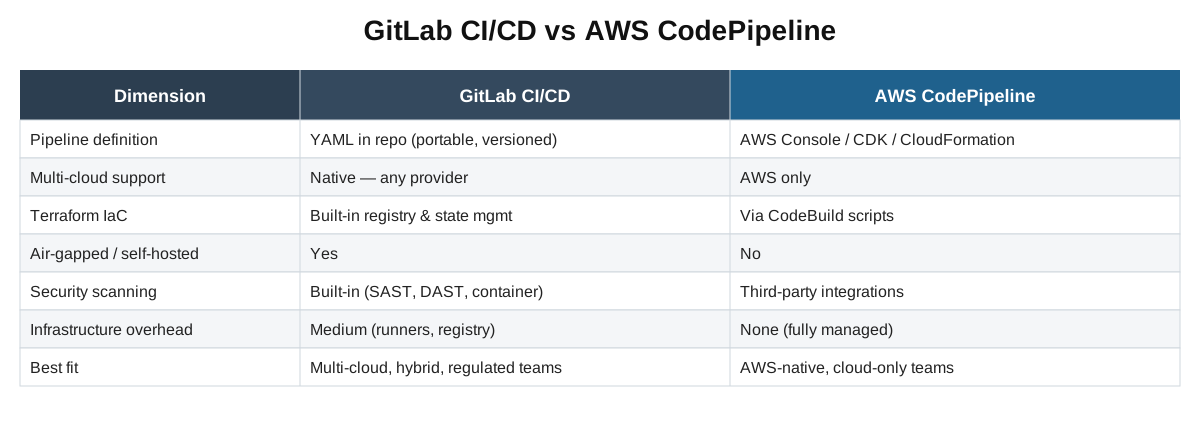
Check this table out for a better look at what both stacks have to offer.
Which CI/CD Stack Is Right for Your Team?
Choose AWS CodePipeline if:
- Your application workload lives entirely inside AWS
- Your team is already fluent in IAM and CloudFormation
- Operational simplicity matters more than portability.
It delivers on its promise cleanly for AWS-native architectures.
Choose GitLab CI/CD if you need multi-cloud or hybrid flexibility, air-gapped deployment capability, native Terraform IaC support, or a pipeline definition that travels with your code.
It’s the tool of choice for teams that can’t afford to lock their DevOps pipeline to a single provider, particularly in regulated industries, government environments, or organizations building across multiple clouds.
For many teams, the decision isn’t binary. Organizations often use GitLab for source control and pipeline orchestration while deploying AWS-native services through CodeDeploy or ECS. That way, they can benefit from the flexibility of GitLab CI/CD alongside the deep integrations of the AWS ecosystem.
As a DevOps development company that specializes in CI/CD implementation, DPL has the experience and expertise to help you make the right choice. So, let us know how we can help your organization.
Frequently Asked Questions
Can GitLab CI/CD deploy to AWS resources?
Yes. GitLab CI/CD is cloud-agnostic and deploys natively to AWS services including ECS, EKS, Lambda, and S3. It utilizes AWS CLI commands, Terraform modules, or custom Docker-based job runners.
Is AWS CodePipeline free to use?
AWS CodePipeline includes one free active pipeline per month. Additional pipelines are billed at $1/month each, with CodeBuild compute billed separately per build minute.
Which tool handles Terraform IaC better?
GitLab has a clear advantage in this regard. It includes a native Terraform module registry, remote state management, and merge request integration for infrastructure plan reviews. So, it’s the stronger choice for Terraform IaC workflows where infrastructure changes need the same rigor as application code.