How to Enforce Consistent Multi-Cloud Security Policies Across AWS, Azure, and GCP

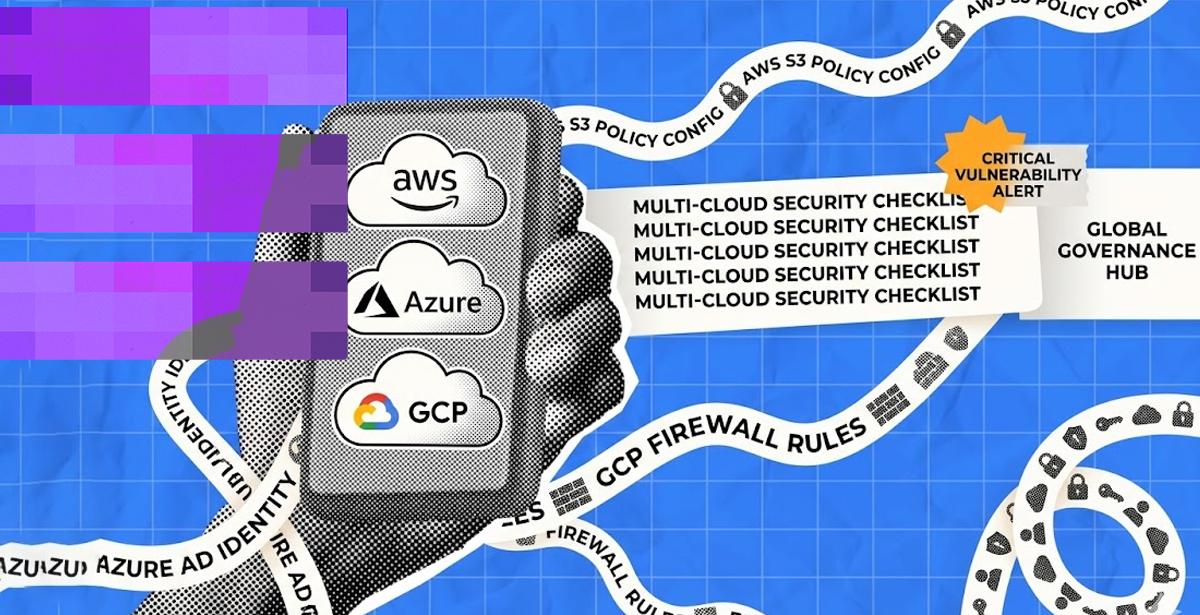
Running workloads across AWS, Azure, and GCP simultaneously is the new normal for serious engineering teams. Unfortunately, this poses a few major risks as well.
One of the biggest risks you can expect stems from the fact that multi-cloud security doesn’t scale automatically with your infrastructure.
Each cloud has its own IAM model, native security toolset, and compliance controls. None of them communicate by default. This results in a policy drift.
A guardrail enforced on AWS goes unmirrored on GCP. An IAM misconfiguration caught by Azure Defender goes undetected in your AWS accounts.
According to the IBM Cost of a Data Breach Report, the average breach now costs $4.88 million. So, unless you wish to part away with a chunk of your revenue, you need to enforce consistent policies across clouds.
Why Multi-Cloud Security Falls Apart at Scale
AWS ships with Security Hub, GuardDuty, and Organizations SCPs. Azure gives you Microsoft Defender for Cloud and Azure Policy. GCP provides Security Command Center and Organization Policies.
But these tools are powerful in isolation. The problem is they’re entirely cloud-specific.
A policy written in AWS Control Tower doesn’t automatically replicate to Azure. Similarly, a threat detected in GCP Security Command Center won’t surface in your AWS Security Hub dashboard.
Multi-cloud architecture creates a distributed attack surface. When teams manage three clouds separately, enforcement becomes inconsistent. Policy updates get applied to one cloud and missed on the other two.
What’s worse is that compliance gaps accumulate quietly. They only become visible during an audit or after an incident.
So, your security posture has to match that distribution.
💡Multi-cloud strategies increase flexibility, but they also expand the security boundary of your applications. That’s why application security in cloud computing must be built with provider-agnostic controls such as unified identity and access management, consistent encryption policies, and centralized monitoring.
Important Measures to Secure Multi Cloud Architecture
Securing multi-cloud requires a unified security approach that spans identity, data, networking, and observability across all cloud environments. Below are the vital practices needed to maintain consistent security, visibility, and governance in a distributed multi-cloud setup.
Build a Cloud-Agnostic Policy Framework First
Before you open a single cloud console, define your policies in code, not in cloud-specific UIs.
The CSA Cloud Controls Matrix (CCM) is the gold standard for this. It maps controls across 17 security domains and aligns with ISO 27001, SOC 2, HIPAA, and GDPR. Use it to define what you need to enforce universally, then translate those controls into cloud-specific implementations.
Open Policy Agent (OPA) is the tooling backbone of this approach. It lets you write policies in Rego. Those policies run against Kubernetes admission controllers, Terraform plan output, and cloud API calls. HashiCorp Sentinel does the same within Terraform Cloud and Terraform Enterprise.
Policy-as-code means your security posture is versioned, reviewable, and deployable. It stops being tribal knowledge locked in someone’s head.
💡SOC 2 compliance is closely tied to multi-cloud security because it’s fundamentally about proving that your systems maintain consistent, auditable controls over data and operations. In a multi-cloud environment, this means enforcing standardized identity and access management, unified logging and monitoring, and consistent encryption and data protection policies across all providers. You can check if you’re ready for the audit by checking our SOC 2 compliance checklist.
Effectively Enforce Policies Across AWS, Azure, and GCP
Once your framework exists, map it to each cloud’s native enforcement layer.
- On AWS: Use Organizations Service Control Policies (SCPs) to set hard guardrails across all accounts. AWS Control Tower enforces a landing zone baseline. Security Hub maps findings to CIS Benchmarks and NIST 800-53. Layer AWS Config Rules for continuous drift detection and auto-remediation.
- On Azure: Azure Policy assignments enforce compliance at the subscription or management group level. Microsoft Defender for Cloud produces a unified secure score and attack path analysis. Azure Blueprints deploy compliant environment baselines consistently.
- On GCP: Organization Policies enforce org-level constraints. They restrict resource regions, prevent public bucket creation, and enforce OS Login. Security Command Center’s Premium tier adds threat intelligence and attack path simulation.
- Cross-cloud enforcement: This is where most teams drop the ball. Platforms like Wiz, Prisma Cloud, and Lacework aggregate findings from all three clouds into a single graph. They normalize alerts, map risks, and give your team unified visibility through one multi-cloud management platform.
Choose a Multi Cloud Management Platform That Delivers
A multi-cloud management platform is non-negotiable at scale. It’s the connective tissue that makes cross-cloud security operational, not theoretical.
A good platform covers four areas:
- A unified asset inventory across all three clouds
- Normalized policy enforcement with cloud-specific remediation
- Identity and entitlement analysis as IAM misconfigurations are the leading attack vector.
- Runtime threat detection for containers and serverless workloads
Wiz leads on agentless inventory and graph-based risk correlation. Meanwhile, Prisma Cloud delivers deeper container and code-level coverage. Moreover, Lacework excels at behavioral anomaly detection.
Whichever you choose, integrate it into your CI/CD pipeline. Security findings that don’t block deployments are suggestions, not controls.
Ensure Hybrid Cloud Security Solutions are Equally Covered
If some workloads remain on-premises alongside your public cloud deployments, the same policy framework applies. Don’t maintain a separate security model for on-prem.
HashiCorp Vault centralizes secrets management across cloud and on-premises environments. Istio mTLS enforces zero-trust network policies across service meshes. It works whether workloads run on EKS, AKS, GKE, or bare-metal Kubernetes.
Effective hybrid cloud security solutions are architecture-native, not patched on after deployment.
DPL deployed this exact architecture for the Pakistan Air Force — a fully air-gapped Kubernetes cluster with Istio mTLS, HashiCorp Vault, and zero security incidents across the deployment.
Know When to Bring in Cloud Security Consulting
Cloud security consulting becomes critical when internal teams lack the depth or bandwidth to design and enforce security across complex cloud environments.
This is especially true in multi-cloud setups, where inconsistent identity models, fragmented logging, and varying compliance controls increase risk.
Experienced consultants help establish secure landing zones, implement least-privilege IAM at scale, and design centralized monitoring and incident response frameworks. They also accelerate compliance readiness for standards like SOC 2, ISO 27001, and industry-specific regulations.
Most importantly, cloud security consulting ensures that security isn’t an afterthought, but embedded into architecture from the start, reducing long-term operational and audit risk.
The Bottom Line
Multi-cloud security isn’t a product you buy. It’s a discipline you enforce at the policy layer, the tooling layer, and the deployment layer simultaneously.
If you are securing regulated workloads or scaling faster than your security team can manage, DPL’s managed cloud services and cloud security consulting capabilities are built for exactly this challenge.
Bonus: Frequently Asked Questions
What is the biggest risk in a multi-cloud security setup?
Policy drift. Controls enforced on one cloud aren’t automatically mirrored across others. Consistent enforcement requires centralized policy definitions and automated compliance checks across all environments.
Can a single tool manage security across AWS, Azure, and GCP?
No single tool covers everything. CNAPPs like Wiz and Prisma Cloud provide unified visibility and normalized findings across all three. Pair them with cloud-native enforcement tools on each individual platform.
What framework should govern multi-cloud security policies?
Start with the CSA Cloud Controls Matrix aligned to your compliance requirements. Then implement policy-as-code using OPA or HashiCorp Sentinel to enforce those controls consistently across every environment.