The Case for True Cloud Modernization: Why Lifting and Shifting Isn’t Enough

Most organizations have run a lift-and-shift at some point. You take an existing application, move it to AWS, Azure, or GCP, and call it cloud migration.
The problem? That’s not cloud modernization. It’s relocation.
When you lift and shift, your application inherits every inefficiency it had on-premises. It still can’t auto-scale intelligently. Moreover, it still runs on rigid infrastructure. So, you now pay cloud prices for on-premises behavior.
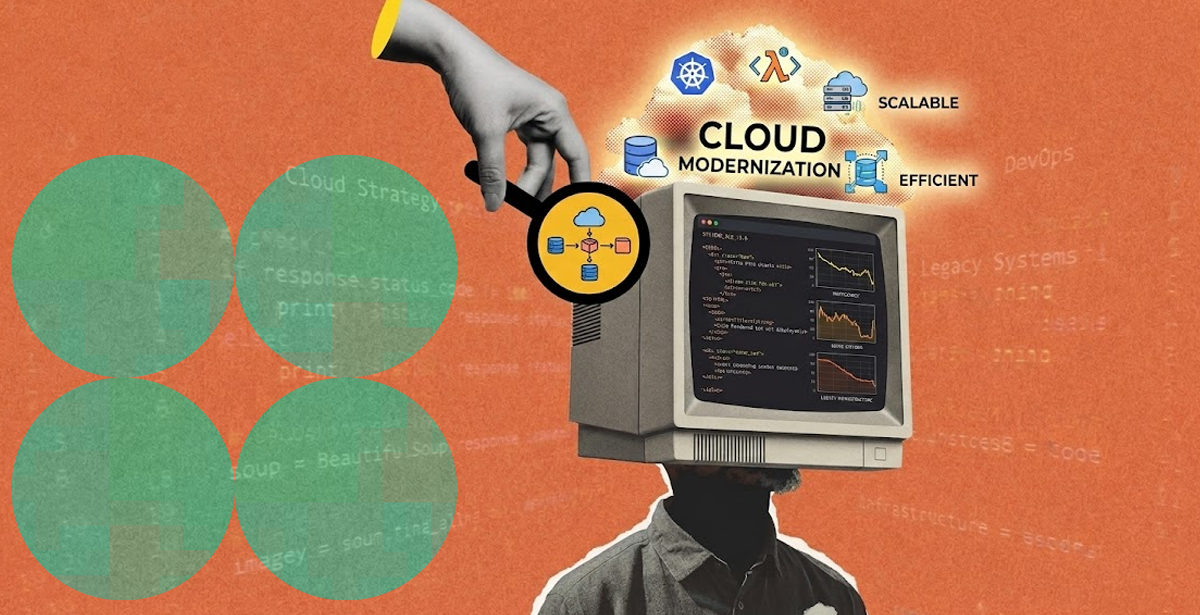
True cloud modernization means re-architecting applications to exploit what the cloud actually offers: elasticity, automation, resilience, and deployment velocity.
Organizations that make this distinction cut infrastructure costs significantly, ship faster, and build systems designed to scale.
A Deeper Look at The Lift-and-Shift Trap
Lift-and-shift is an appealing shortcut. It’s fast, relatively low-risk, and checks the “moved to cloud” box. But it creates a false sense of progress.
What you don’t get are:
- Intelligent auto-scaling, cloud-native security controls
- Serverless cost models
- Managed database services
- Pipelines that deploy in minutes.
Instead, you get the same application in a new location.
Research from McKinsey & Company found that organizations relying solely on re-hosting capture less than 30% of the value available from cloud adoption. The rest sits locked behind modernization.
What Cloud Modernization Actually Means
Cloud modernization isn’t a single action — it’s a deliberate architectural shift.
This means decomposing monolithic applications into microservices, containerizing workloads with Kubernetes and Docker, implementing CI/CD pipelines for automated delivery, and adopting managed cloud services that eliminate undifferentiated infrastructure work.
Cloud native application development transfers platform reliability to the infrastructure layer. Your teams stop patching servers and start shipping features.
💡The biggest mistake in cloud modernization is treating cloud-native development as a later phase instead of a guiding principle. When teams design applications for cloud constraints from day one, modernization becomes smoother and less disruptive. This approach reduces rework, accelerates delivery, and ensures that applications are built to fully leverage the scalability and resilience that cloud platforms are designed to provide. So, make sure to learn everything there is to developing cloud applications before jumping into cloud modernization.
Why Legacy Application Modernization Can’t Wait
Every day a legacy application runs unmodified in the cloud, technical debt compounds. Maintenance costs rise. Security gaps widen. Developer velocity drops.
Legacy application modernization isn’t optional for teams serious about staying competitive. And the question isn’t whether to modernize; it’s related to sequence and pace.
You don’t have to modernize everything at once. A phased approach — starting with the highest-cost or highest-risk workloads — lets you move incrementally without disrupting the business.
Proven techniques like the Strangler Fig pattern, event-driven refactoring, and API abstraction layers make this achievable without stopping production.
💡Choosing the right cloud modernization tech partner is less about tooling and more about transformation capability. Look for a partner who understands legacy systems deeply, applies cloud-native architecture principles, and embeds automation through CI/CD and DevOps practices. The right cloud application development services should modernize without disrupting business continuity, reduce technical debt, and design for scalability and resilience—ensuring your cloud journey delivers long-term agility, not just infrastructure migration.
Picking the Right Cloud Migration Solution for Each Workload
Not every application needs the same treatment. A sound cloud migration solution maps the right approach to each workload.
The main paths are:
- Re-platforming (minimal changes to adopt managed services)
- Re-factoring (restructuring code for better cloud-fitness)
- Re-architecting (decomposing monoliths into microservices for full cloud-native performance)
For mission-critical systems, re-architecting returns the most value — but requires the most planning. For stable, lower-criticality workloads, re-platforming can unlock meaningful savings with minimal disruption.
Selecting the right path is where expert cloud modernization services separate outcomes from wishful thinking.
What a Real Modernization Engagement Looks Like
Real cloud modernization starts with assessment, not assumption.
DPL’s application modernization engagements begin with a current-state architecture review –
- What’s running?
- How are components coupled?
- Where are bottlenecks?
- Which workloads benefit most from cloud-native patterns?
From there, we define a migration roadmap sequenced by value and risk. We containerize where it makes sense, build automated DevOps pipelines for continuous delivery, and instrument every layer for observability from day one.
The result isn’t just cloud deployment. It’s a platform that can evolve.
Frequently Asked Questions
How long does cloud modernization take?
It depends on application complexity and scope. A single workload can be modernized in weeks. An enterprise-wide program typically runs 12–24 months in structured phases.
What is the difference between cloud migration and cloud modernization?
Migration moves an application to the cloud. Modernization makes it cloud-native. Most organizations need both, and sequence matters.
Is cloud modernization worth the investment?
Yes — when you track the right metrics. Deployment frequency, incident rate, cost per transaction, and developer velocity reveal modernization ROI far better than infrastructure savings alone.
Conclusion
Lift-and-shift gets you into the cloud. But cloud modernization makes the cloud work for your business.
Organizations extracting the most from their cloud investments treat migration as the starting line, not the finish. They re-architect for scale, automate delivery pipelines, and retire technical debt systematically.
If your current cloud strategy isn’t delivering expected ROI, the answer is rarely more migration. It’s modernization.
DPL’s cloud modernization services help engineering teams move from lift-and-shift to cloud-native — with the architecture decisions and deployment patterns to back it up. Explore what true cloud modernization looks like for your organization.