A Step-by-Step SOC 2 Compliance Checklist for Cloud-Native Companies

SOC 2 certification has become the de facto trust signal for cloud-native companies selling to enterprises. Without it, deals stall, vendor questionnaires pile up, and procurement teams walk.
The good news: getting there isn’t a mystery. It’s a process.
And knowing what to check off an SOC 2 compliance checklist will helo you breeze through the stages you need to complete.
But First, Let’s Go Over SOC 2 Type 1 vs Type 2
Before you build a plan, know what you’re working toward.
SOC 2 Type 1 is a point-in-time assessment. An auditor reviews your controls on a specific date and confirms they’re designed correctly. It’s faster to achieve, typically 2 to 3 months, and useful as an early trust signal to customers.
SOC 2 Type 2 covers a monitoring period, usually 6 to 12 months. The auditor verifies that your controls not only exist but operated effectively over time. This is the standard most enterprise buyers require.
Approaching SOC 2 Type 1 vs Type 2 in sequence is a common strategy. Achieve Type 1 to unlock early deals while the Type 2 monitoring period runs concurrently. Most SaaS companies need Type 2 within 12 to 18 months of their first enterprise contract.
The Five SOC 2 Compliance Requirements
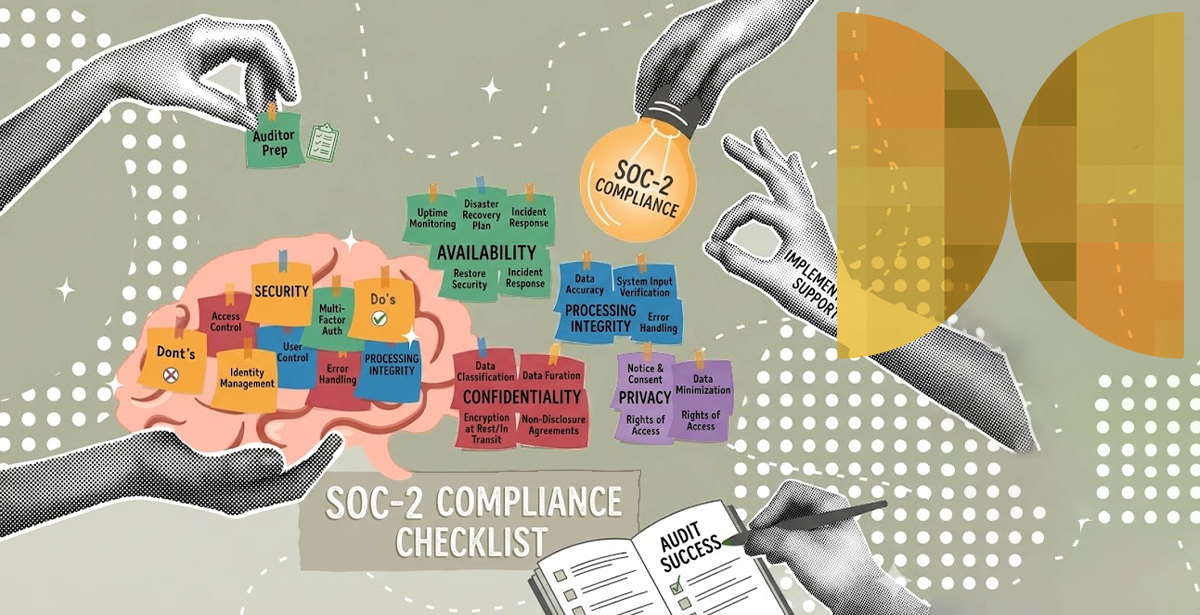
SOC 2 compliance criteria are structured around five Trust Service Criteria (TSC), as defined by the AICPA. Not all five are mandatory, but scope decisions made here shape everything that follows.
- Security — Access controls, encryption, vulnerability management, and incident response. Required for every audit.
- Availability — Uptime and performance commitments. Relevant if customers depend on your platform being online.
- Processing Integrity — Data is processed completely, accurately, and on time. Applies to financial or transactional systems.
- Confidentiality — Sensitive data is protected throughout its lifecycle.
- Privacy — How personal data is collected, used, and shared. Relevant under GDPR or CCPA obligations.
Make sure to define which criteria apply to your product before anything else. Scope creep at this stage costs months.
The SOC 2 Compliance Checklist: Six Phases
The following checklist breaks the process into six clear phases, helping organizations move from initial readiness assessment to audit completion and sustained compliance with greater clarity and control.
Phase 1 — Scoping
- Identify which Trust Service Criteria apply to your product
- Map systems, services, and data flows in scope
- Define the audit boundary: what’s in, what’s out
- Document third-party vendors and subprocessors within scope
Phase 2 — Gap Assessment
- Audit current controls against SOC 2 requirements
- Document gaps: missing policies, unmonitored access, unencrypted data stores
- Prioritize remediation items by risk level and audit impact
- Assign owners and deadlines to each remediation item
Phase 3 — Control Implementation
- Deploy technical controls: MFA, encryption at rest and in transit, network segmentation, least-privilege IAM
- Implement security tooling: WAF, GuardDuty, Security Hub, Secrets Manager, CloudTrail
- Write and ratify security policies: access control, incident response, change management, vendor management
- Train staff on new controls and policies
Phase 4 — Evidence Collection
- Configure continuous logging across all in-scope systems
- Set up automated alerting for policy violations and anomalies
- Document every security incident, infrastructure change, and access review
- Build the centralized evidence repository your auditor will need
Phase 5 — Readiness Review
- Run an internal audit or engage a cloud consulting partner for an independent readiness review
- Remediate remaining gaps before the formal engagement begins
- Select a licensed CPA firm to conduct the SOC 2 audit
- Confirm the audit period start date for Type 2 engagements
Phase 6 — The Audit
- Type 1: point-in-time review of control design — typically completed in 4 to 8 weeks
- Type 2: monitoring period review (6 to 12 months) of control operation effectiveness
- Respond to auditor requests for evidence and clarification promptly
- Address any findings before the final report is issued
Knowing what to expect beforehand helps you make more informed decisions, set realistic goals, and avoid common pitfalls that can slow down execution or inflate costs. However, make sure to learn about the steps your tech partner follows for added clarity.
💡If you’re hesitant about hiring external consultants, you may be holding on to common myths that don’t reflect how modern consulting actually works. Today’s software development and consulting firms act as hands-on partners who bring specialized expertise, accelerate execution, and help avoid costly trial-and-error. In many cases, they complement internal teams rather than replace them, making delivery faster, more focused, and more outcome-driven.
Cloud Security Standards to Have in Place
SOC 2 doesn’t mandate specific tools. But companies running on AWS, Azure, or GCP have a well-established set of cloud security standards that map directly to SOC 2 controls.
- Encryption -TLS in transit, AES-256 at rest, KMS-managed keys throughout.
- Access Control – MFA enforced organization-wide, IAM with least privilege, Secrets Manager for all credentials.
- Monitoring – CloudTrail for API activity, CloudWatch for anomaly detection, Security Hub for centralized findings.
- Network Security – VPC segmentation, WAF rules, PrivateLink for internal service traffic.
- Vulnerability Management – Container image scanning, automated patch cycles, and DevOps pipeline security gates at build time to catch issues before they reach production.
Many of these controls also satisfy ISO 27001, HIPAA, and GDPR requirements. Building them once covers multiple frameworks. That’s a significant efficiency gain for teams pursuing more than one certification.
How DPL Helped NJS Achieve SOC 2 Type II
Cloud compliance solutions are most effective when built into the architecture from the start, not retrofitted before the auditor arrives.
NJS is a facility management company processing 500,000+ work orders annually across 50 US states. They engaged DPL to modernize their cloud infrastructure and achieve SOC 2 Type II certification simultaneously.
DPL implemented the full compliance stack on AWS: ECS containerization, multi-region disaster recovery with RTO under 15 minutes, and automated CI/CD pipelines via CodePipeline. End-to-end audit logging ran through CloudTrail and Security Hub.
The results of these changes were:
- SOC 2 Type II certified
- Platform availability: 99.95%
- Infrastructure costs reduced by 35%
- Deployment time: 4 hours → under 1 minute
- Disaster recovery RTO: under 15 minutes
- Manual deployment effort reduced by 90%
- Zero security incidents post-deployment
Compliance didn’t slow the build. It was part of it.
DPL’s Managed Cloud Services carry the compliance weight — architecture, controls, evidence collection, and audit-readiness — so your team focuses on shipping product.
You can check the full DPL cloud portfolio for more deployments across government, SaaS, IoT, and logistics.
Planning on Getting Your SOC 2 Certification?
SOC 2 certification isn’t a one-time project. It’s an operational capability. Cloud-native companies that build compliance into their architecture from the start avoid the audit scrambles that derail less-prepared teams.
Use this SOC 2 compliance checklist as your starting framework. Validate it against your product’s specific scope and customer commitments. Get the foundations in place before the auditor arrives.
If you’re preparing for certification, talk to DPL’s cloud team about building a compliance-ready architecture for your environment.