Cloud Cost Optimization With Serverless: Why 68% Infrastructure Savings Is Achievable

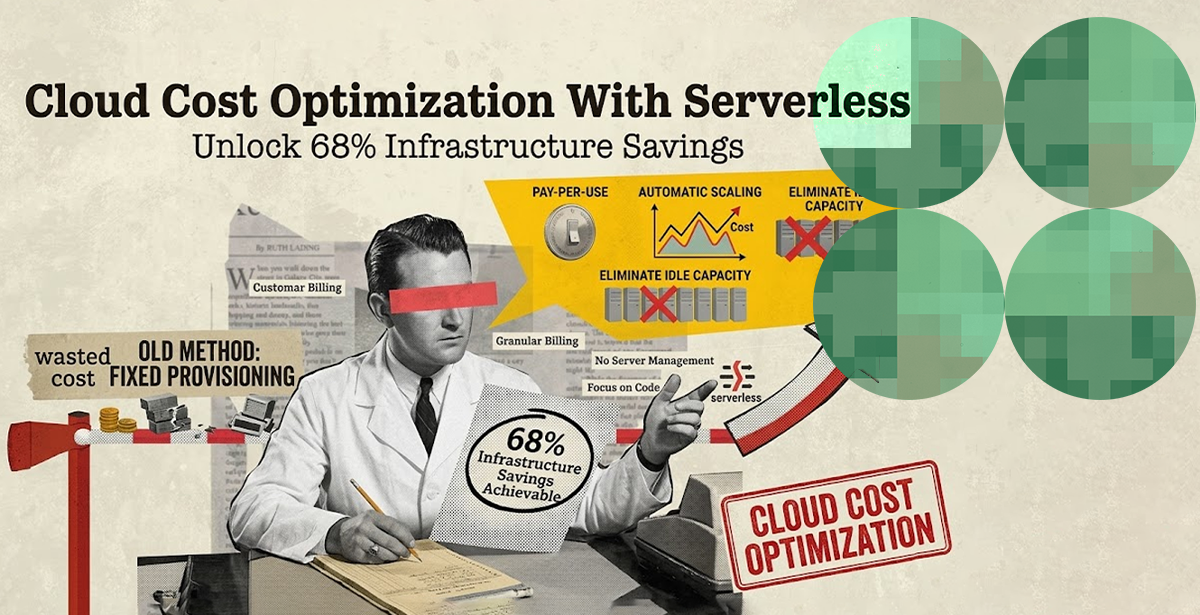
Cloud bills keep climbing. Budgets get set, infrastructure gets provisioned, and workloads change. But servers remain the same. The result is wasted compute, rising costs, and engineering teams managing infrastructure instead of building product.
Serverless architecture changes that math. It eliminates idle compute entirely and ties cost directly to usage. When applied correctly, cloud cost optimization strategies built around serverless can yield dramatic reductions.
Why Most Cloud Bills Stay Bloated
Most cloud waste has one root cause: paying for compute you’re not using.
Traditional server-based architectures require provisioning for peak load. But peak load is rare. The rest of the time, instances sit idle — still running, still billing.
According to Flexera’s annual research, enterprises waste roughly 30% of cloud spend on idle or underutilized resources.
Effective cloud cost management starts with a harder question: does this workload actually need a persistent server?
For APIs, background jobs, event processors, and scheduled tasks, the answer is often no. That’s where serverless earns its place.
💡 Remember: cloud cost optimization should be treated as a continuous business strategy, not a one-time infrastructure exercise. Without active monitoring, rightsizing, and architectural optimization, cloud environments can quickly accumulate unused resources, inefficient workloads, and escalating operational costs that erode the value of digital transformation initiatives. Just make sure to thoroughly understand what cloud cost optimization services can do for you before contracting one.
What Serverless Actually Means for Your Budget
Serverless doesn’t mean there are no servers. It means you don’t manage them, and you don’t pay for them when idle.
In practice, this means AWS Lambda functions that execute on demand and Amazon API Gateway for routing. It also means DynamoDB tables that scale without capacity planning.
Billing shifts from provisioned instance hours to per-invocation and per-millisecond of execution. A function handling zero requests costs exactly zero.
This is a fundamentally different cost model. For the right workloads, it’s transformative.
How this Architecture Achieved 68% Savings
nGAGE at Work needed to serve multiple enterprise clients simultaneously. Requirements included complete tenant isolation, instant scalability, and infrastructure costs that could shrink during off-hours.
DPL built the platform entirely on serverless infrastructure. Our team used AWS Lambda for compute, API Gateway for routing, and DynamoDB with row-level security for tenant-isolated data. Automated workflows ran through Step Functions, with Cognito handling authentication.
The results were direct and measurable:
- Infrastructure costs dropped 68% versus an equivalent EC2-based setup
- Tenant onboarding fell from 2 days to under 5 minutes
- API response times held under 200ms at P95
- The platform auto-scales to zero during off-peak hours
Beyond cost, serverless removed infrastructure management overhead from the engineering team entirely.
Cloud Cost Optimization Strategies That Actually Deliver
The nGAGE outcome wasn’t luck. It came from applying structured cloud cost optimization strategies during architecture, not as a post-launch patch job.
Here are four strategies we used and know can drive the most impact.
1) Match Compute to Workload Pattern
Variable, event-driven workloads are the ideal serverless candidates. nGAGE’s API traffic peaks during business hours and drops sharply overnight. Serverless auto-scales to zero between peaks. This means zero idle cost with no manual intervention.
2) Eliminate Provisioned Capacity
Replacing EC2 instances with Lambda and switching DynamoDB to on-demand mode removes capacity planning entirely. This eliminates a major source of cloud spend management overhead and wasted budget.
3) Isolate Tenants at the Data Layer
Row-level DynamoDB security serves all tenants from one table. That too at far lower cost than per-tenant RDS instances. For multi-tenant SaaS, this single architecture decision can cut database costs by 60–80%.
4) Automate Provisioning End to End
Step Functions and CloudFormation automate tenant onboarding and prevent resource sprawl. The AWS Well-Architected Cost Optimization framework identifies this pattern as foundational to sustainable cloud cost optimization services.
When Serverless Isn’t the Right Tool
Serverless is powerful, not universal.
Sustained, high-throughput workloads such as video encoding, long-running ML inference and scientific modeling often run cheaper on reserved EC2 or containers. For these, Kubernetes cost optimization applies: right-sizing pods, using spot instances, and applying Horizontal Pod Autoscaler.
Persistent TCP connections, stateful processing, and workloads with strict cold-start constraints also don’t belong on serverless.
The right cloud optimization strategy depends entirely on your workload profile. That’s why you need to thoroughly brief your cloud managed service providers to effectively map workloads to the right compute model before any infrastructure is committed.
Don’t Miss Your Chance to Optimize Your Cloud Costs
Cutting your cloud bill by 68% isn’t magic. It’s the result of choosing the right architecture for the right workload.
And if there’s one thing we know from projects such as nGAGE, it’s that modern SaaS infrastructure can be dramatically cheaper without trading performance, security, or scale. The same principles apply to IoT platforms, API backends, and event-driven enterprise systems.
If your cloud spend is growing faster than your product, that’s a signal worth acting on. Connect with our experts to learn how our cloud strategy consulting services can assist your teams to design for cost efficiency from the start. Before inefficiency compounds.