Replace In-House Ops With Cloud Managed IT Services

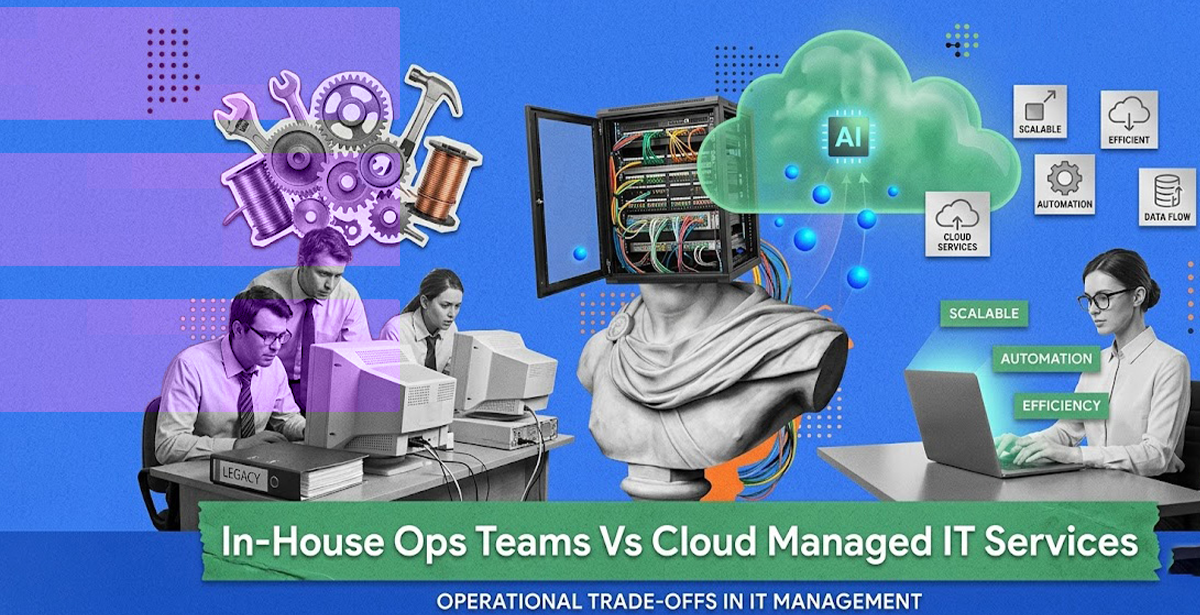
Running your own infrastructure ops is expensive, slow, and hard to justify. Most organizations spend more keeping the lights on than building the products that generate revenue.
Cloud managed IT services change this equation.
Instead of maintaining an in-house ops function with full-time headcount and 24/7 coverage, you hand that operational burden to a partner built for exactly this. Your team gets back to the work it’s actually there to do.
This post makes the case for that transition — and what to look for when you’re ready to make it.
The Real Cost of Running Ops In-House
According to Flexera’s State of the Cloud report, 82% of enterprises name cloud cost management and governance as their top challenge. The technology isn’t the constraint. The operational capacity to manage it well is.
The visible costs are easy to list: salaries, tooling licenses, cloud spend. The hidden costs are what actually slow organizations down –
- On-call rotations burn out your best engineers.
- Security patching gets deprioritized when sprints are full.
- Nobody owns the alerting strategy until an outage exposes the gap.
- Hiring a senior DevOps engineer takes months. Keeping one is a second full-time job.
Cloud managed services solve exactly this. You’re not outsourcing your product. You’re offloading the infrastructure work your product doesn’t differentiate on.
Cloud MSP vs. In-House: The Honest Comparison
Two objections always come up when organizations consider moving ops to a cloud MSP: control and security. Both are valid concerns, yet both are misplaced when you examine what a capable managed provider delivers.
- Control – A good managed cloud service provider runs your infrastructure against your architecture decisions, your tooling choices, and your compliance requirements. You don’t give up control. You delegate the execution.
- Security – A dedicated provider maintains security depth continuously. In-house teams often have one security-focused engineer, if they’re lucky.
External providers staff certified specialists, run threat intelligence programs, and deploy tooling like GuardDuty, Security Hub, and HashiCorp Vault as a standard baseline. Keeping ops in-house at half the capability of a specialist team is the actual risk.
What Cloud Managed IT Services Actually Cover
A mature cloud managed IT services offering covers the full operational surface, not just a monitoring dashboard and an SLA document.
Infrastructure Management
This covers provisioning, scaling, patching, and rightsizing across your cloud environment. The infrastructure stays current and optimized without your engineers touching it.
24/7 Monitoring and Incident Response
Not just alerts, but diagnosis and resolution. Mean-time-to-recovery measured in minutes, not hours.
Security and Compliance
You should expect coverage for WAF rules, vulnerability scanning, IAM governance, audit logging, and compliance posture management for SOC2, ISO 27001, HIPAA, and GDPR.
Cost Optimization
This entails reserved instance planning, rightsizing, and auto-scaling that prevents runaway cloud spend.
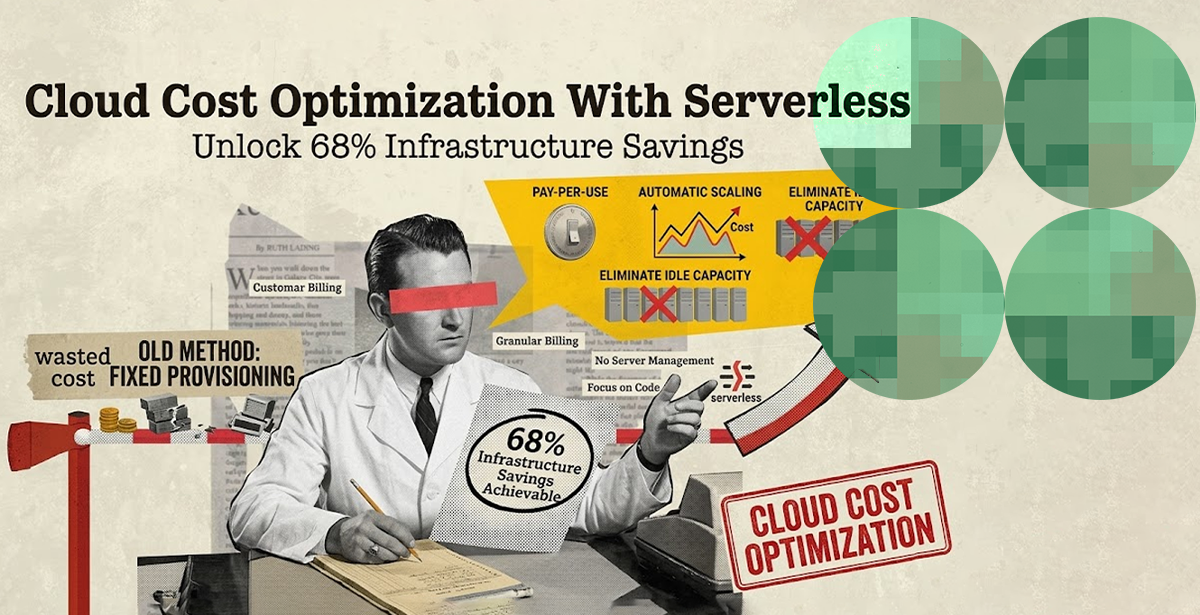
💡 As stressful as cloud costs can get, there are several tactics to help you slash them. One of the most effective is adopting serverless architecture, where you only pay for actual compute usage instead of idle infrastructure. With serverless, workloads automatically scale up and down based on demand, eliminating the need to provision and maintain always-on servers. This reduces wasted capacity, especially for variable or event-driven applications. By combining serverless functions with proper monitoring, efficient execution time design, and optimized memory allocation, businesses can significantly ensure cloud cost optimization.
CI/CD and DevOps Automation
As part of this service, providers include pipeline management and deployment coordination so engineers ship code, not configuration files.
The right cloud MSP handles all of this. Your team stops getting pulled back into infrastructure problems.
What Cloud Infrastructure Managed Services Should Include
When evaluating cloud infrastructure managed services, push past the marketing and ask for specifics.
What are the SLA guarantees, and what are the penalties when they’re missed? What does the incident response playbook look like? Which tools handle monitoring, logging, and secrets management? How long before onboarding reaches steady-state operations?
For organizations with compliance requirements, ask how the provider handles audit evidence collection, control mapping, and access governance. Compliance is an operational discipline. It doesn’t run itself.
Gartner’s research on managed cloud services consistently names incident response depth and SLA transparency as the top selection criteria for enterprise buyers. Tool breadth is secondary.
DPL’s Managed Cloud Services are grounded in real production delivery. We manage infrastructure processing 500,000+ annual work orders, 200,000+ connected IoT devices, and classified government systems. That track record is visible in the DPL cloud portfolio.
Cloud Managed Services in Action
Here’s what DPL-managed cloud operations looks like in practice — two engagements with hard numbers.
National Janitorial Solutions (NJS) — Cloud ERP & Managed DevOps
NJS processes 500,000+ work orders annually across 50 US states. DPL manages their complete AWS environment: multi-region disaster recovery, automated CI/CD pipelines, and SOC2 Type II compliance.
- Infrastructure costs down 35%
- Deployment time: 4 hours → under 1 minute
- Platform availability: 99.95%
- Recovery time objective: under 15 minutes
- Manual deployment effort reduced by 90%
iApartments — Cost-Optimized IoT Cloud Platform (AWS)
DPL has been iApartments’ core cloud partner since 2019 — from MVP through Series A and beyond. We manage 200,000+ connected IoT devices (locks, thermostats, lights) across multi-region high availability.
- Cost per device: under $1/month
- Message latency reduced by 92%
- MTTR improved by 60%
- 300% business growth supported without re-architecture
- Zero security incidents across the full engagement
DPL’s cloud management services engagement starts before the contract is signed. We run a cloud consulting session to understand your current architecture, identify operational gaps, and define what managed operations looks like for your specific environment.
From there, we build the full operational model: monitoring, alerting, response runbooks, DevOps pipeline integration, and a security baseline tuned to your stack and compliance posture.
Your Search for a Managed Cloud Service provider Starts Here
In-house ops made sense when cloud was new and managed providers were immature. That calculus has changed.
Cloud managed IT services now deliver better reliability, stronger security, and lower total cost than most internal ops functions can match. Teams that make the shift recover their engineers, stabilize their infrastructure, and meet compliance requirements without the organizational strain.
If you’re ready to make that move, talk to DPL’s cloud team about what managed operations look like for your environment.