
Platform Engineering vs DevOps: The Layers of Modern Engineering

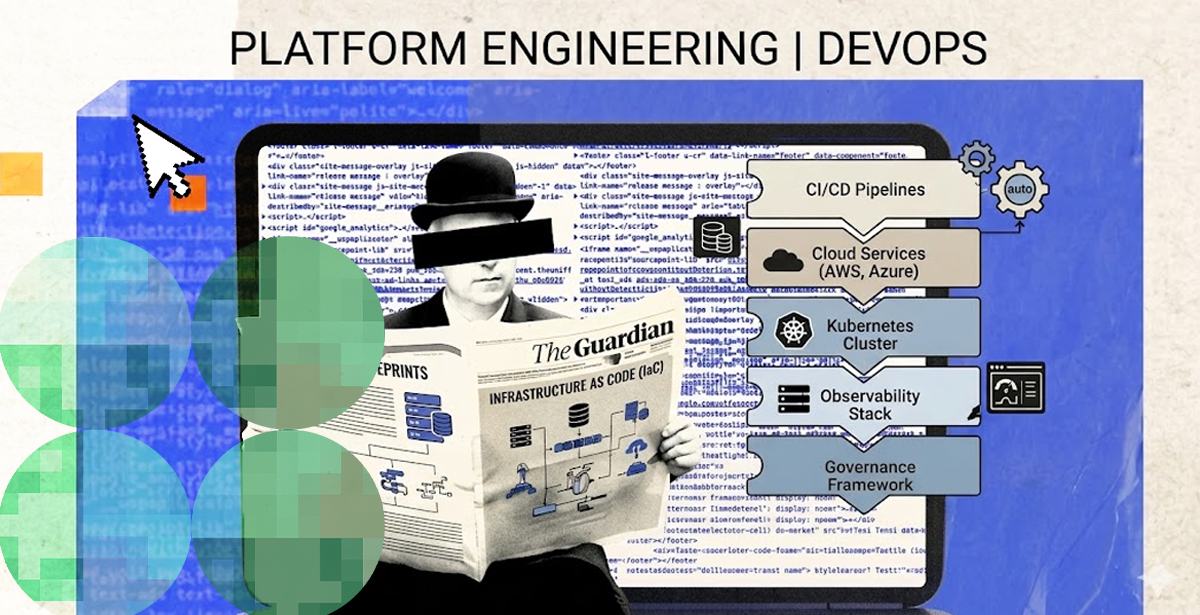
DevOps has been the backbone of modern software delivery for over a decade. It brought development and operations closer together, automated deployments, and helped teams ship faster with fewer failures.
But as systems have grown more distributed, cloud-native, and tool-heavy, a new challenge has emerged: teams are spending more time managing infrastructure complexity than actually building software.
This is where platform engineering enters the picture. Instead of replacing DevOps, it builds on it, internal platforms that standardize workflows, abstract away infrastructure complexity, and give developers a self-service experience.
But since the developer community enjoys a little comparison, there’s always the question of platform engineering vs DevOps.
While there’s really no competition since both disciplines solve different problems at different levels of the engineering stack, let’s go deeper into each.
What Is Platform Engineering?
Platform engineering is the practice of building internal developer platforms (IDPs). These platforms provide shared infrastructure, tooling, and workflows so product teams can build and deploy without constant ops intervention.
Platform engineers own CI/CD pipelines, infrastructure-as-code templates, container orchestration standards, secrets management, and observability stacks. Their output is a product. Their customers are internal engineering teams.
The CNCF Platform Engineering Whitepaper describes the discipline as designing toolchains that enable self-service capabilities for software engineering organizations. The goal is reducing cognitive load on developers. Developers should be shipping features, not fighting infrastructure.
A mature platform team doesn’t just maintain infrastructure. It treats developer experience as a product problem, with feedback loops, SLAs, and versioned releases.
What DevOps Actually Means
DevOps isn’t a job title. It’s a set of cultural and engineering practices — continuous integration, continuous delivery, infrastructure as code, monitoring, and feedback loops — designed to eliminate the wall between development and operations.
At its core, DevOps is about shortening feedback cycles. Code gets tested faster. Defects get caught earlier. Deployments stop being quarterly events and become daily operations.
💡DevOps is the foundation that makes CI/CD effective by unifying development and operations around automation, collaboration, and continuous feedback. By integrating code integration, automated testing, and deployment pipelines, continuous integration and continuous deployment eliminates manual handoffs and reduces release friction. In a mature DevOps environment, every code commit can trigger a fully automated pipeline that builds, tests, and deploys changes within seconds. This tight feedback loop not only accelerates deployment speed, but also improves reliability, as issues are detected early and resolved before reaching production.
Platform Engineering vs. DevOps: The Core Differences
To put it simply, DevOps defines how your organization should work. On the other hand, platform engineering builds the infrastructure that makes working that way practical.
Here’s a table to explain this further.
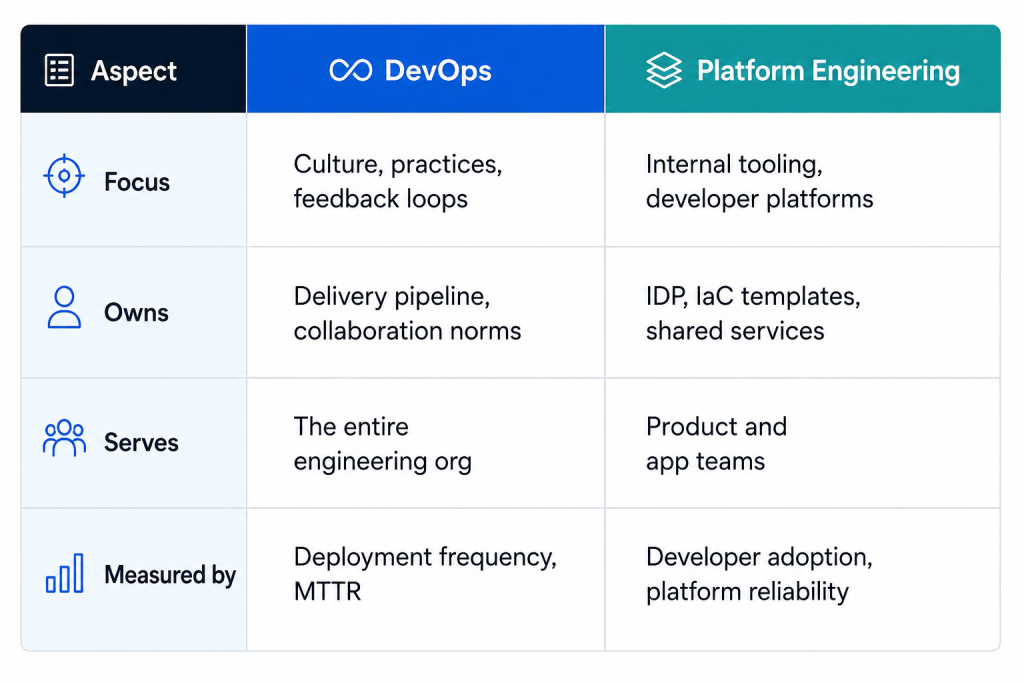
In a mature organization, DevOps engineers on product teams use the internal platform their platform team built. They are different roles solving different scopes of the same problem.
Bonus: SRE vs DevOPs
Site Reliability Engineering (SRE) is a third discipline that gets conflated with both. Understanding the distinction matters when designing your org structure.
SRE originated at Google as a way to apply software engineering principles to operations problems. SREs define SLOs, manage error budgets, write toil-reduction automation, and own production reliability. They are fundamentally engineers who happen to run production systems.
DevOps is the broader cultural practice. SRE is one concrete implementation of DevOps principles. It applies stricter measurement, explicit error budgets, and a hard bias toward automation over manual ops work.
Platform engineering sits adjacent to SRE. Both care deeply about reliability and reducing toil. Where SRE focuses on production system health, platform engineering focuses on the internal systems developers use to reach production.
How Platform Engineering and DevOps Work Together in Practice
Platform engineers build golden paths: opinionated, pre-configured workflows that let teams deploy without building custom CI/CD pipelines from scratch.
A DevOps engineer on a product team takes those golden paths and adapts them. They configure deployments, tune observability, and handle team-specific integration requirements. They aren’t reinventing infrastructure — they are driving on roads the platform team built.
Our Pakistan Air Force deployment shows this in practice. DPL decomposed 100+ monolithic apps into containerized microservices on an air-gapped cluster. The platform team built the pipeline. DevOps teams ship daily.
Do You Need a Dedicated Platform Engineer?
Not every organization needs a dedicated platform team on day one. But most growing engineering teams reach a point where the absence of one creates measurable drag.
The signal is this: when developers spend more time configuring infrastructure than writing features, you have a platform problem. When every team maintains its own bespoke CI/CD setup, you have a standardization problem. Both are platform engineering problems.
For teams of 5–10 engineers, a senior DevOps engineer can cover both roles. Past 15–20 engineers across multiple services, a dedicated platform engineer pays for itself. Reduced toil and faster onboarding are the immediate returns.
When DevOps Consulting Makes the Difference
Not every organization has the internal capacity to build out DevOps practices and platform infrastructure simultaneously. That is where DevOps consulting adds genuine value.
The right DevOps consulting services goes beyond configuring pipelines. It audits your current delivery workflow, identifies the highest-leverage improvements, and implements them with your team. The outcome is a repeatable playbook your engineers own.
That’s exactly what we did for National Janitorial Solutions.
DPL’s DevOps work spans air-gapped Kubernetes for defense to fully automated pipelines. For the client, this meant daily deployments and a 90% reduction in manual deployment effort. It also allowed tjem to become SOC 2 Type II certified, and process 500,000+ annual work orders.
The Bottom Line
Platform engineering and DevOps aren’t competing philosophies. They’re complementary disciplines operating at different scopes.
DevOps defines the culture and practices. Platform engineering builds the infrastructure those practices run on. And if you’re still wondering, SRE measures and enforces reliability against what ships through that infrastructure.
Organizations that get this right ship faster and onboard new engineers in days, not weeks. They stop losing senior engineers to repetitive infrastructure toil.
If you’re building out DevOps practices, standing up platform infrastructure, or both — DPL’s DevOps services and solutions are built for exactly this kind of transformation. So, get in touch to discuss your needs with our team.
Frequently Asked Questions
What is platform engineering?
Platform engineering is the practice of building internal developer platforms. These platforms provide shared infrastructure, tooling, and CI/CD workflows for developer self-service — so product teams can build and deploy without ops intervention at every step.
How is platform engineering different from DevOps?
DevOps is a set of cultural and engineering practices focused on delivery speed and reliability. Platform engineering builds the internal tooling that makes those practices scalable across many teams simultaneously.
What does a platform engineer do?
A platform engineer owns the internal developer platform: CI/CD pipelines, IaC templates, container orchestration standards, secrets management, and observability stacks. Their customers are internal development teams.